


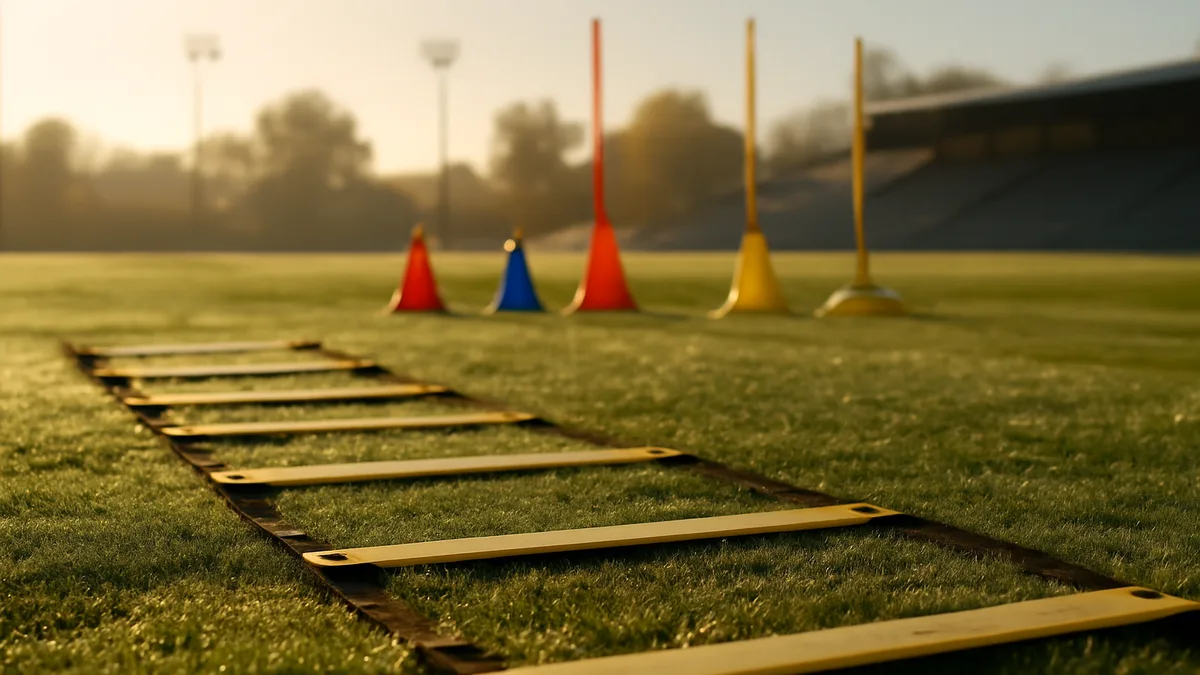
Buying agility kit is really a decision about three things: what athletic quality to train, where the drills will take place, and how often the equipment must be handled. Ladders, cones and poles are complementary tools; the choice rests on which qualities need emphasis and how robust the kit must be.
This guide presents a priority sequence of checks to run through before spending money. Each heading stands on its own so a single point gives usable advice for a quick purchase decision.
Training goal
Decide the primary quality to develop: foot speed, change of direction, or body positioning. Agility ladders are best where rapid, repetitive foot contacts and coordination matter; cones serve lateral change-of-direction and spatial awareness; poles demand posture, hip-turns and striking clearance. Buy the tool that matches the skill most often practiced rather than one that looks most versatile.
Surface and grip
Match the tool to the main training surface because stability depends on it. Hard, flat surfaces suit ladders with thin rungs and cones that won’t sink; natural grass needs cones and poles with broad bases or ground anchors to resist tipping. If sessions move between turf and indoor courts, prioritise versions that include weighted or spike bases for stable placement.
Durability and construction
Choose materials and joins that tolerate the intended usage pattern. Cones made from thicker, flexible PVC tolerate repeated impacts and kicking; poles with reinforced collars resist repeated racking from knocks; ladders with welded or fused rungs will last longer than tape-only ladders when used heavily. For regular team use prefer heavier construction; for occasional individual practice lighter kit is acceptable.
Portability and pack size
Consider how often the kit will be moved and by whom. Collapsible poles and roll-up ladders are easier to transport between venues, while large cone sets are bulkier even if they pack into a single bag. If a single person carries kit alone, prioritise lightweight, compact options and simple organisation solutions such as colour-coded bags.
Precision and repeatability
Decide how precise the drill layout must be from session to session. Fixed-length ladders and graduated poles give consistent measurements for testing and progression; cones are quick to reconfigure but harder to place to exact distances without a tape measure. For testing or repeatable assessment, choose kit designed to align to measured markers.
Adjustability and progression
Buy tools that allow gradual progression so the same kit remains useful as ability improves. Poles that vary in height or that accept crossbars create more drill options, and cones that stack or are available in different sizes extend drill complexity. Ladders that permit rung spacing changes let a single piece of kit serve multiple drill intensities.
Set size and drill variety
Pick a quantity that suits group size and the drills planned. Larger squads need more cones to run simultaneous lanes, while a single ladder is often enough for one-to-one work. Consider whether the set includes extras — markers, rings, or carry bags — that broaden the exercises possible without buying separate items.
Maintenance, replacement and warranty
Check how easy it is to replace individual parts and whether the maker offers a warranty or spares. Cones and poles are consumables and will be lost or damaged; models with replaceable bases or snap-in poles reduce long-term cost. For heavy-use environments such as clubs or schools, prioritise brands or suppliers that publish spare-part options.
Table: how the tools compare
| Tool | Best for | Portability | Setup time |
|---|---|---|---|
| Agility ladder | Foot speed, coordination, contact timing | High when roll-up; low when rigid | Very quick — unroll and start |
| Cones | Change of direction, spatial drills, marking lanes | Moderate — many items to carry | Moderate — placing several markers takes time |
| Poles | Body positioning, evasion lines, overhead work | Variable — collapsible poles are portable | Moderate to slow — requires anchors or insertion |
How to decide in ten minutes
Run a quick checklist: name the dominant skill to train this month, note where most sessions happen, estimate how often kit will be moved, and count the typical group size. If foot speed and coordination top the list and sessions stay in one place, an agility ladder should be the first purchase. If lateral acceleration and decision-making feature most, begin with a cone set sized for the group. If posture and obstacle navigation matter, add poles that can be fixed safely on the surface used.
Where people go wrong
Buyers often pick the flashiest or cheapest kit rather than matching the tool to the drill. Common mistakes include buying a rigid ladder for multiple surfaces, choosing lightweight cones for heavy team use, and selecting poles that fail to anchor on grass. Another frequent error is ignoring storage: bulky sets left in garages degrade much faster than stored, organised kit.
Beginner versus experienced athlete
Beginners benefit from simple, forgiving equipment: low-profile ladders, large stable cones and short poles reduce early frustration and injury risk. Experienced athletes need adjustable spacing, measured layouts and more demanding pole heights to force technical adaptations. Design purchases so that the beginner path is available at first but progression paths exist without replacing the entire kit.
What to do next
List the specific drills intended for the next three months and map each drill to the tool named in this guide. Buy the item that covers the most drills and the most frequent surface; if budget permits, add one complementary piece to expand variety. Finally, plan storage and a small spares kit — a few extra cones and replacement pole tops will extend the utility of any set.
Frequently asked questions
Which tool improves foot speed fastest?
Agility ladders are the most direct way to train rapid, repetitive foot contacts and coordination. For transfer to sport-specific movement, combine ladder drills with cone-based change-of-direction work to add deceleration and re-acceleration elements.
What should I buy for mixed indoor and grass use?
Prioritise kit that is stable and portable: roll-up ladders and cones with weighted or spike-capable bases work across surfaces. Choose poles that either collapse or have interchangeable bases so they can be anchored on grass and stabilised on hard courts.
How many cones and poles does a small team need?
A set should allow multiple lanes and variety, so buy more cones than players to permit simultaneous drills and staggered layouts. For poles, a small team needs enough to create two or three obstacle lines so groups can rotate through different technical stations.
