


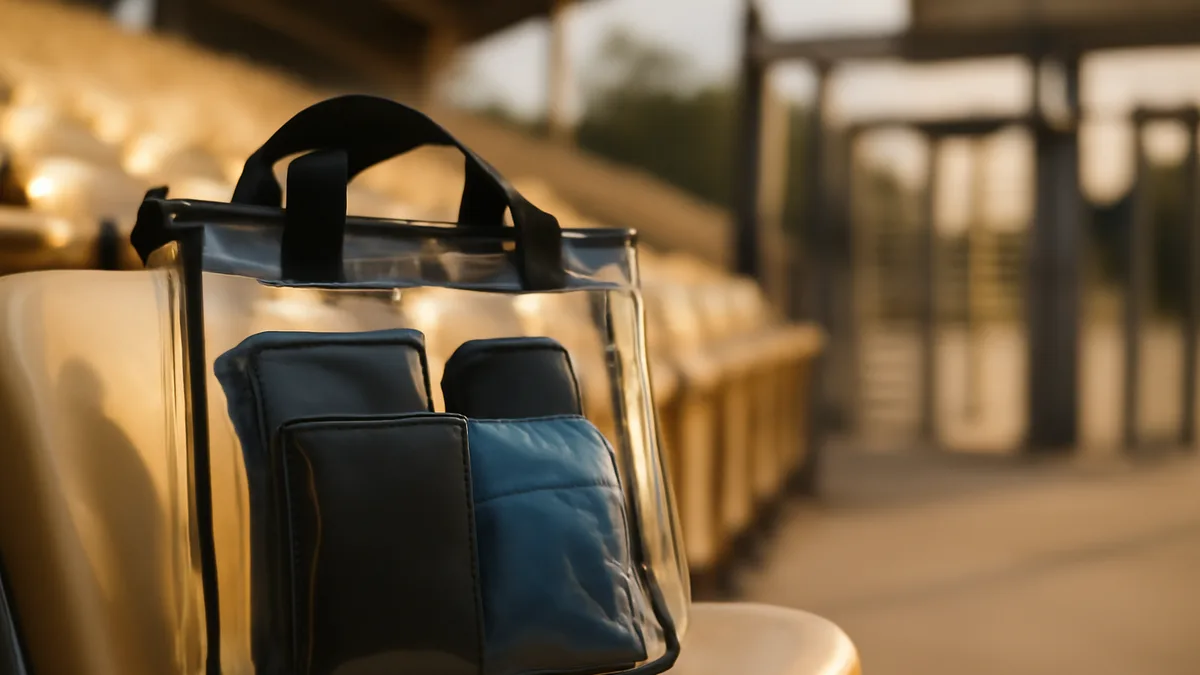
Stadium entry policies are short and strict: many venues limit bag size or only allow transparent sacks, and most ban weapons, outside food, and loose bottles. The decision when packing is a simple trade-off between what is permitted, what must be accessible during the event, and what can be left in a safe place.
This guide lists the priority checks in the order that matters when preparing for a match or concert. Each point stands alone so someone who only reads one heading still gets usable advice.
Priority checklist: the order that matters
Know the venue rule first
Start by checking the venue’s published entry rules because they are decisive. Many clubs and arenas publish a clear-bag policy and a prohibited-items list that override general advice; breach those rules and entry can be refused even for otherwise ordinary items.
Choose the right bag type
Select a bag whose material and dimensions comply with the venue’s limits, not a bag that simply feels convenient. Clear plastic, mesh, and small clutch options satisfy most policies; backpacks and duffels often fail size checks unless the venue explicitly allows them.
Prioritise essential contents
Pack only what will be needed during the visit: tickets or phone for entry, wallet or card, any required medication, and a compact layer for weather changes. Anything not essential increases screening time and raises the chance of being asked to return the item to a vehicle or leave it with a friend.
Handle prohibited items before arrival
If an item is banned — for example loose glass, large containers, or professional camera equipment — arrange an alternative before travel. Options include leaving items at home, storing them in the car, or using a paid cloakroom if the venue offers one.
Plan accessibility and pockets
Keep small, frequently used items in an external pocket so they can be shown without unpacking the whole bag. Phones, cards and medication should be easy to present during bag checks; removing them repeatedly slows both entry and personal movement inside the venue.
Decide on electronics and recording gear
Assume professional lenses, large tripods and certain audio recorders are prohibited unless pre-cleared by the venue. For personal use, a compact smartphone or a small point-and-shoot is usually acceptable, but check the policy for explicit camera rules.
Choose a secure temporary storage option
If something must be left behind, prefer an official bag drop or locker over an unmonitored vehicle, and keep proof of ownership with the stowed item. Public transport hubs and stadium car parks carry theft risk; paid cloakrooms or secure lockers minimise that risk where available.
Account for group needs and mobility
When attending with others, coordinate who carries shared items like sunscreen, a spare layer or medication to limit the number of bags. If mobility is an issue, pick a bag that sits comfortably and allows hands-free movement; a small crossbody or a compliant sling bag is often easier than a full backpack.
Manage food and drink expectations
Assume outside food and drink are restricted in most major venues; if dietary needs require personal items, carry documentation and route them through the designated entry lanes. For non-essential snacks, rely on stadium concessions to avoid confiscation at the gate.
Table: comparing common bag choices
| Bag type | Visibility under rules | Capacity | Best use |
|---|---|---|---|
| Clear plastic tote | High — usually allowed | Moderate — fits essential items | General matches where clear bags are required |
| Mesh bag | High — accepted by many venues | Low to moderate | Warm-weather events and quick entry |
| Small clutch/sleeve | Low — easily inspected | Very low — cards and phone only | Short visits or VIP entry |
| Backpack | Low — often refused | High | When venue explicitly permits or for long trips with storage |
How to decide: a short process
Make the decision in three steps. First, find the venue rules and note size/material restrictions; these remove unsuitable options instantly. Second, list what must be on the person during the visit; anything not on that list is a candidate to leave behind or place in temporary storage. Third, pick the smallest bag that meets both the rules and the must-carry list; smaller compliant bags reduce the chance of inspection delay.
Where people go wrong
Common mistakes include assuming policies are uniform across venues, overpacking ‘‘just in case’’, and relying on locker space that may not exist. Another frequent error is bringing items that require additional screening — for example large metal drink flasks or professional camera equipment — without checking whether pre-clearance is available.
Beginner versus experienced fans
Beginners should prioritise simplicity: a compliant clear or mesh bag and a basic checklist for essentials avoids surprises. Experienced attendees can refine: carry compact multi-use items, plan arrival times to avoid peak checks, and identify secure storage options at the venue in advance so non-essential gear need not be carried in.
What to do next
Before travel, open the bag and pack only the essentials identified here, then measure it against the venue’s published limits. If any item is banned, use a secure alternative: leave it at home, place it in a vehicle trunk, or use an official cloakroom or locker. Arrive early and have items presented for inspection in an organised way to speed entry.
Frequently asked questions
What counts as a permitted stadium bag?
Permitted bags are defined by the venue: many accept clear plastic or mesh bags under a specific size, while small clutches for essentials are often allowed. Backpacks and large duffels are frequently banned unless the venue states otherwise.
Can I bring medication into a stadium?
Medication is usually allowed but should be carried in its original packaging or accompanied by documentation if required by the venue. Keep it accessible in an external pocket so it can be shown quickly at security checks.
Where can I store items I cannot bring inside?
Options include leaving items in a locked vehicle, using an official stadium cloakroom or paying for a secure locker where offered. Public areas and unattended bags increase theft risk, so prefer venue-managed storage when available.
