


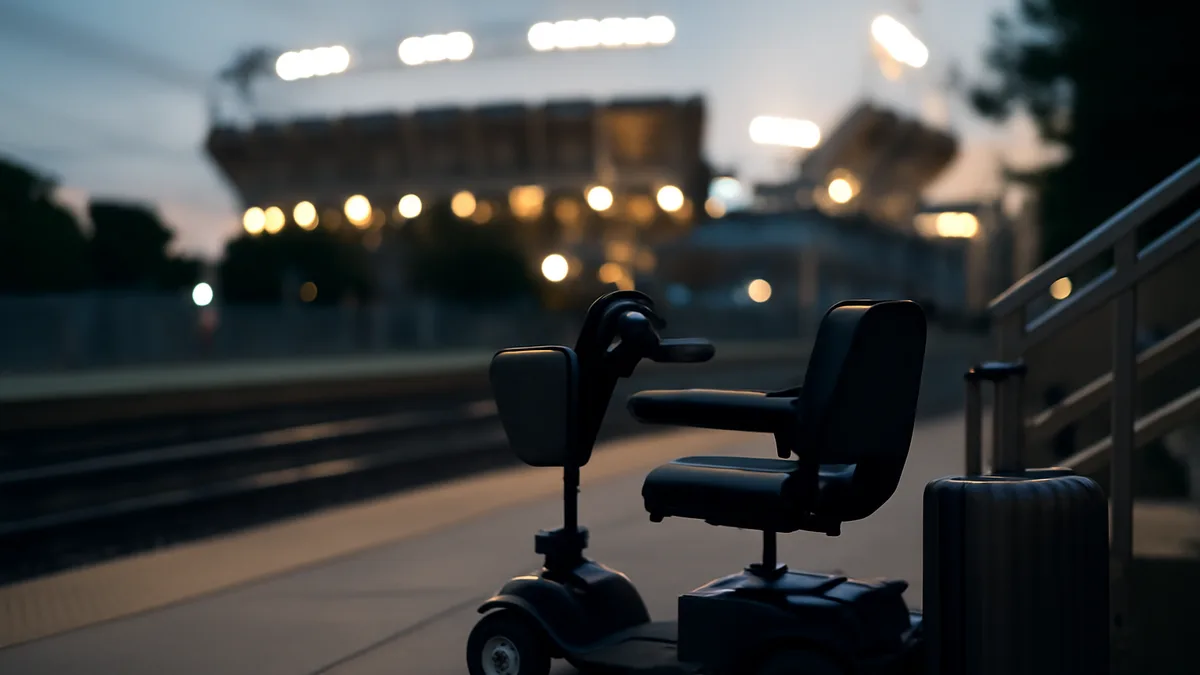
Accessible travel to a stadium turns on four things: a reliable route, confirmed seating and entry arrangements, an appropriate transport mode, and an agreed plan for help on arrival and return. Getting those four right before buying a ticket removes most barriers on matchday.
This guide explains the priority decisions, in the order they matter, and what to check with the club, transport operator and box office. It names the standard places to look for official policies and shows how to choose between rail, bus, tram, driving or ride-hail when access needs are the deciding factor.
Decision checklist: priorities before booking
Before committing money, confirm these essentials. First, check that the stadium’s accessible entry points and viewing positions match the type of mobility aid or assistance required. Second, ensure the transport operator publishes step-free routes or assistance options. Third, verify the club’s companion ticket policy and where companion seats are located. Fourth, decide the fallback if your primary plan fails: alternative transport, a different entry gate, or contacting the club’s accessibility team on the day.
Clubs and transport providers often list policies online, but specifics—such as whether a companion ticket is free or discounted, or if a tram stop has a ramp—are sometimes only confirmed by phone or email. When possible, get written confirmation by email so it can be shown on arrival if needed. The Americans with Disabilities Act is the baseline for many US operators, and national rail providers in other countries have their own published rules; for long-distance rail journeys look for Amtrak accessibility details when relevant.
Priority sequence: nine essential checks before payment
Accessible arrival point
Confirm which stadium entrance is step-free and closest to accessible seating. Some stadiums have multiple accessible gates with different facilities; choose tickets that match the entrance rather than the cheapest gate-adjacent seat.
Companion ticket rules
Check whether a companion ticket is included, discounted, or must be bought separately, and where companion seats are located. A companion placed several rows away is not usable for people who need physical assistance.
Transport assistance booking
Book any required assistance with the transport operator in advance—this includes ramp requests on trains, bus kneeling, or assistance at a major interchange. Operators often require 24 to 48 hours’ notice for guaranteed help.
Step-free route confirmation
Map the door-to-door route and confirm step-free access at all transfer points: station entrances, platform access, and street crossings. An otherwise step-free journey can fail at a single inaccessible interchange.
Seating specification
Choose seating that suits the mobility aid and sightline needs, and confirm whether transfer space is required or a wheelchair space will be provided. Note if the accessible bay has fixed seats that reduce flexibility for large wheelchairs or powered chairs.
Accessible facilities on site
Confirm location and usability of toilets, changing places, and first-aid rooms relative to accessible seating. Some stadiums place facilities in different stands; plan restroom or refreshment breaks around that layout.
Entry and bag policy
Check security and bag policies to ensure any medical or mobility equipment is allowed and how early to arrive for searches. If early arrival is advised for accessibility checks, factor that into transport reservations.
Return journey booking
Reserve return assistance or a pick-up if the return involves a fixed service that could be busy after the event. Peak egress times can overwhelm on-demand services; pre-booked return help reduces waiting time and stress.
Fallback and contact plan
Note the club accessibility contact, an alternative route, and a transit customer-service number. If something changes on the day—station closures or staff shortages—having these contacts avoids last-minute confusion.
Transport modes compared
Choosing a transport mode depends on predictability and how much assistance a person needs. The table below compares common options on four practical axes. Use it to decide which mode best matches single-trip certainty, ability to book assistance, step-free reliability and on-the-day flexibility.
| Mode | Predictability | Assistance booking | Step-free reliability | On-the-day flexibility |
|---|---|---|---|---|
| Rail | High for scheduled services | Usually available with advance notice | Varies by station; main stations often better | Lower if services are altered |
| Bus | Moderate; subject to traffic | Limited; drivers provide ramp but not always guaranteed | Good on newer networks; dependent on stop infrastructure | Good for short, local trips |
| Tram/Light rail | High on fixed routes | Often accessible with level boarding | Usually reliable where platforms match vehicle floor | Moderate; network disruptions affect coverage |
| Ride-hail / Taxis | Variable; dependent on vehicle availability | Some services offer wheelchair-accessible vehicles by request | Depends on vehicle stock in the area | High — door-to-door option |
| Private car | High if traffic is predictable | Driver assistance depends on driver; parking may require reservation | High to stadium lots, but venue drop-off points vary | High control over schedule |
Where organisers and travellers commonly go wrong
First, assuming an accessible ticket equals accessible arrival. A ticket for an accessible seat does not guarantee accessible transfer from the station or drop-off point. Second, neglecting the return trip. Services are busiest after events; failure to pre-book assistance can result in long waits. Third, not getting confirmation in writing. Verbal assurances from a call centre may not be enough at a congested entry gate.
Another frequent error is treating staff knowledge as consistent. Different stewards and drivers can have different interpretations of policy. When an arrival or departure depends on staff action—operating a ramp, permitting an alternate entry—having a named contact or written confirmation reduces the chance of disagreement.
Beginners versus experienced travellers
Beginners should prioritise predictability and arrive early. Choose a single, well-documented route with one operator if possible, and avoid complex interchanges. Pay particular attention to companion ticket rules and book assistance for every leg of the journey, including the return.
Experienced travellers can tolerate more complexity to save time or cost. They can mix modes—rail into a park-and-ride then a shuttle bus—if they have contingency contacts and familiarity with local accessibility variations. Experienced travellers also carry physical copies of confirmations and photos of step-free routes and key signage to show staff quickly.
What to do next
Decide the top two criteria for the trip: guaranteed assistance or lowest number of transfers. Use those to eliminate unsuitable transport modes, then confirm companion ticket availability and accessible entry with the club by email. Book transport assistance for both directions and save all confirmations where they can be retrieved offline. If uncertainty remains, choose an option with a named accessibility contact and confirm the plan again 48 hours before travel.
Frequently asked questions
Do clubs include companion tickets automatically?
Policies vary by club and competition. Some clubs include a free companion ticket where a fan has an approved need; others offer a discounted companion seat or require a separate purchase. Always ask the club box office and get the wording of the policy in writing if a companion seat is essential.
How far in advance should I book transport assistance?
Most operators ask for advance notice to guarantee assistance, commonly 24 to 48 hours, though some require longer for long-distance services. Confirm the operator’s specific window and book the return leg at the same time to secure both journeys.
What proof should I carry for accessible entry?
Carry the event ticket showing accessible seating, any written confirmation from the club about companion arrangements, and transit assistance booking references. Photocopies or screenshots stored offline are useful if mobile networks are unreliable.
