


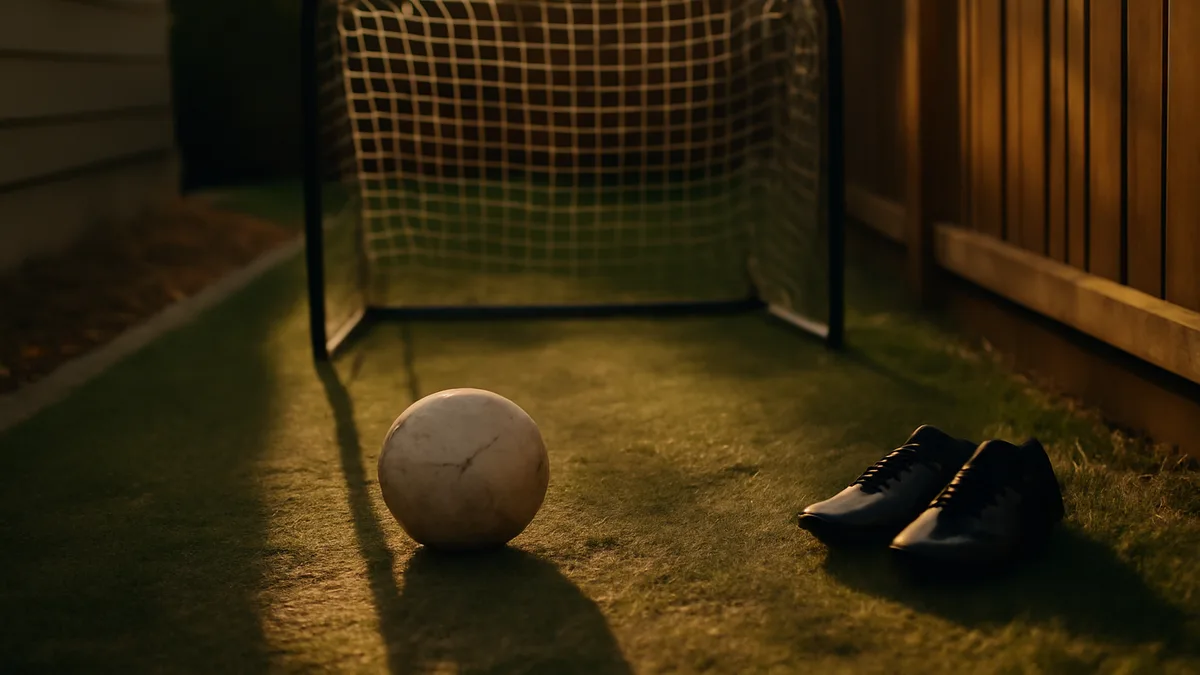
Buying a rebounder or practice net turns on three things: the space available, the skills to train, and what the mounting surface will tolerate. Size and angle determine the return; frame and netting decide durability and how close it can sit to a fence or wall.
This guide lists the priority checks in the order they matter when spending money. Each item names the decision to make and gives a clear, practical rule to follow so the purchase matches a garden, drive or indoor training room.
How to decide before the list
Measure the available footprint first. Mark the real obstacles: fences, flowerbeds, garage doors and overhead branches. A rebounder that fits on paper can still be the wrong choice if it forces repeated movement of pots or storage boxes every session.
Decide the skills you will use most. High-velocity passing and first-touch drills need a firm, predictable return; volley and save practice can tolerate a softer, angled rebound. The same size and angle that helps ball control will make shooting practice awkward.
Priority checks in purchase order
Frame type
Choose the frame before anything else because it limits where the unit can go. Tubular steel frames offer the best combination of rigidity and stake-down options, while lightweight aluminium frames are easier to move but can flex under repeated high-velocity strikes. Foldable frames (hinged or pop-up designs) suit mixed-use household storage but check the hinge strength if the plan includes persistent heavy kicking.
Net material and attachment
Pick netting by how it returns the ball and how it attaches to the frame. Bungee or shock-cord nets give a springier, livelier return and tolerate off-centre impacts better; braided poly or nylon nets give a crisper, faster rebound and last longer under UV. Attachment style matters: a net hooked to multiple tension points produces an even surface, while a single-centre system concentrates wear and can flap against fences.
Size and footprint
Match the size to available space and the drill type. Larger panels produce longer return angles and are better for full-power passing and goalkeeper reaction work, while compact rebounders suit tight gardens and footwork drills. Consider also the footprint for staking or ballast: a nominally small frame may still need an outsized clear area to absorb the return safely.
Angle and adjustability
Buy an adjustable-angle unit if drills will vary. Steeper angles give high, softer returns used for volley practice and aerial control; shallow angles return the ball faster and flatter for passing and one-touch repetition. Fixed-angle panels can be fine for single-purpose use, but adjustable brackets extend the range of drills without changing equipment.
Anchoring and stability
Decide how the unit will be secured where it sits. Ground stakes are effective on turf and soft soil but will not hold on concrete or patios; sandbags or water ballast are better there. Anchoring solutions should be chosen to avoid transmitting impact forces to nearby fences or walls, which causes both structural damage and faster wear of the rebounder.
Surface compatibility
Match the base and feet to the surface to prevent slips and accidental damage. Rubberised feet or wide base plates distribute impact on artificial turf and protect lawn thatching, while narrow spike feet sink into loose ground but can cut turf and loosen paving. For patio or driveway use, a low-profile frame with rubber contact pads reduces scuffing and avoids chipping masonry.
What damages a fence
The common causes are repeated concentrated impact, net flapping and incorrect anchoring. If a rebounder is placed too close, even a moderately springy net can whip into fence slats and chip paint or bend panels; a unit that shifts on kick can press bracing posts beyond their yield point. Always leave a clearance zone and choose a net and frame that absorb rather than transmit the majority of the impact.
Portability and storage
Consider weight and folding method if sessions will be moved often or stored indoors. Units that disassemble into small sections or collapse flat are easier to store in a shed or boot, but the portability mechanism should not be the fragile part of the structure. If storing outdoors, evaluate corrosion resistance: galvanised or powder-coated finishes resist rust where damp winters are expected.
Accessory compatibility
Decide whether the rebounder must accept targets, goals or throwing pockets. Some frames are designed to take clip-on target boards, rebound pockets, or full goal nets; others are single-purpose. Choosing a modular frame saves cost later if training needs expand to shooting, target passing, or hand-feed rebound drills.
Common buying mistakes
Buyers often choose by headline size rather than return behaviour and then complain the unit is “too slow” or “bouncy” for the intended drill. Another frequent error is underestimating anchoring needs: a cheaper, very light unit may be portable but will move repeatedly on strong passes, damaging both the kit and nearby fences. Finally, selecting a product because a brand dominates advertising ignores whether that brand’s line matches the required angle range, net type, or frame anchoring the buyer actually needs.
What differs for beginners and experienced players
Beginners benefit from softer returns and compact units that emphasise control over pace; a small, shock-absorbing net at a steeper angle keeps the ball approachable and reduces intimidation. Experienced players need firmer, larger panels with adjustable shallow angles to recreate game tempo and to practice one-touch passing or keeper reflexes. Experienced users also place higher value on robust anchoring and modular accessories for mixed drills.
| Type | Return speed | Garden suitability | Typical footprint |
|---|---|---|---|
| Tubular-frame rebounder | Fast to very fast, depending on net | Good if staked; keep clearance from fences | Medium to large |
| Bungee/shock-cord panel | Springy, lively return | Better for tight spaces if angle steep; avoid close fences | Small to medium |
| Solid rebound board | Consistent, predictable return | Good near walls if padded; rigid mounting required | Medium |
| Foldable pop-up net/goal | Softer, slower return | Excellent for mixed family gardens and storage | Small to medium |
What to do next
Measure the training area, note the surface type and decide the dominant drills. Test the clearance by marking a throw line and simulating the return path to avoid fence contact. If the purchase will be used on a hard surface, plan for ballast rather than stakes and choose a frame with rubber contact points.
Finally, shortlist units that match the frame, net type and angle range required, and check their anchoring options. Where a brand is specifically chosen because its product line is known for a feature — for example, shock-cord nets or heavy tubular frames — confirm that the model has that feature rather than assuming it does.
Frequently asked questions
What size rebounder fits a small garden?
Measure the clear area and leave a safety margin for the return path; a compact panel or shock-cord net with a steep angle usually fits small gardens without requiring a large footprint. Prioritise units that fold flat or disassemble for storage if space is limited.
How close can a rebounder be to a fence?
Keep a clearance zone so the net and frame do not contact the fence on impact; the exact distance depends on net spring and angle but never place a high-return or shallow-angle unit directly against a fence. Use a softer, steeper-angle net or additional padding if closer placement is unavoidable.
Which rebounder types work on hard surfaces?
On concrete or patio, choose frames that use ballast (sandbags or water weights) and rubberised feet to prevent slipping and surface damage. Avoid spike feet and confirm the frame finish resists corrosion where damp or salty conditions exist.
