


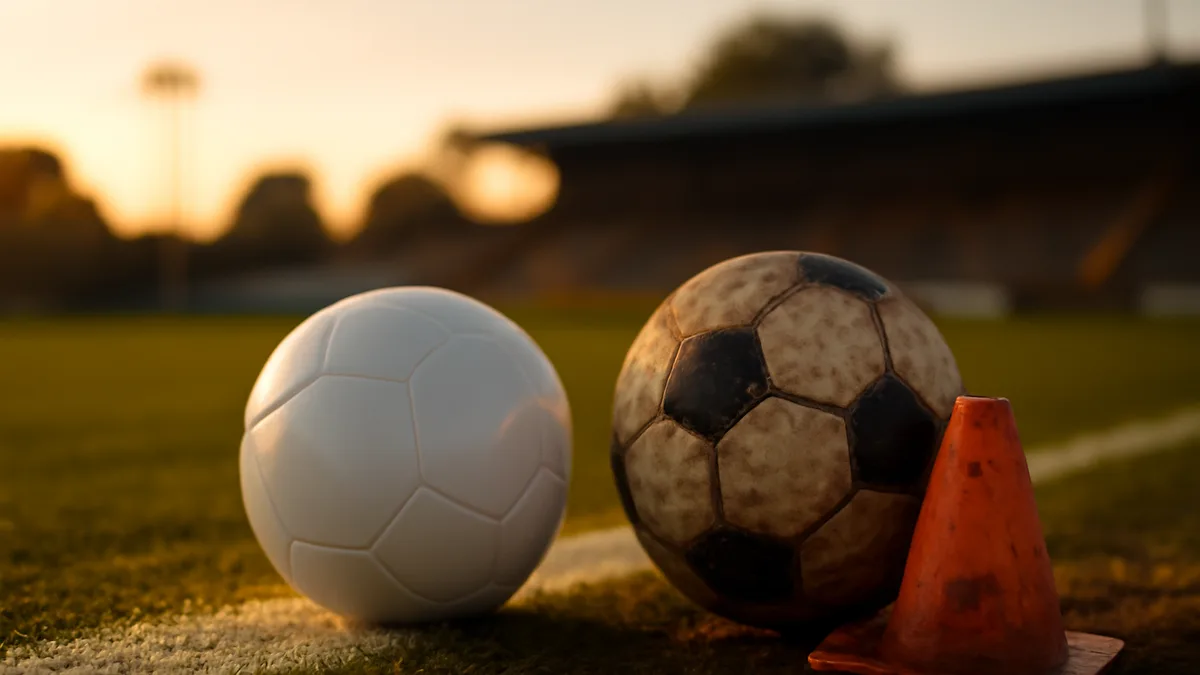
Picking between a match ball and a training ball comes down to what the ball must do and how long it must do it. A match ball focuses on consistency for a small number of games; a training ball gives up a degree of that precision to survive hundreds of sessions.
The most useful way to choose is to work down a short list of priorities: the property that matters most for the way the ball will be used, then the next, and so on. The sections that follow put those priorities in order, explain the technical differences, and show the common buying mistakes to avoid.
Key differences, ranked by how often they matter
The points below are ordered. Start at the top when deciding for match play; work further down when durability and cost control are more important. Each item names the thing that changes between match and training balls and gives a short, practical rule of thumb.
Construction and shell: bonded shell versus stitched shell
The shell construction is the single clearest distinction. Match balls commonly use thermally bonded panels or very fine machine stitching to create a seamless surface that behaves predictably. Training balls more often use conventional stitched panels with thicker seams because those seams tolerate repeated impacts and rough surfaces. Choose a bonded-shell ball if surface smoothness and aeroplane-flat flight are priorities; pick a stitched-shell training ball if repeated knocks and abrasion are expected.
Panel count and panel shape
Panel layout affects predictability in flight and control. Higher-end match balls often have fewer, larger panels shaped to reduce seam interference with airflow, which makes trajectory more repeatable. Training balls usually have more conventional hex/ pentagon layouts or more panels with visible seams; the result is a ball that is less fussy to manufacture and cheaper to repair mentally during long sessions. If consistent flight for shooting or goalkeeper practice matters, favour the match-style panel design.
Bladder quality and retention
The inner bladder determines how well the ball keeps pressure and how it feels underfoot. Match-grade balls use thinner, more responsive bladders designed for immediate touch and low rebound variation; training balls typically use thicker bladders prioritising puncture resistance and shape longevity. If the priority is a consistent touch over a tournament or a season of matches, the match-oriented bladder is the right choice. For boot-room use and heavy everyday practice, the training-style bladder is the safer pick.
Water uptake and outer materials
Outer materials and seam sealing control how much water the ball soaks up in wet conditions. Match balls use sealed or synthetic laminates that reduce water uptake to maintain weight and balance in rain; many training balls still pick materials where some water absorption is acceptable because those grades trade off cost against absolute wet performance. When matches are played in wet climates, prioritise a low-uptake outer; for indoor or dry-pitch work the trade-off is less critical.
Shape retention and long-term deformation
Shape retention is about how the ball resists going oval after many kicks. Match balls are built to keep their roundness for the span of several high-level games; training balls accept a slower change in shape so they last longer in service. If the budget allows, rotate a small pool of match balls through important fixtures and use training balls for the bulk of practice to keep match balls within their designed shape window.
Grip, surface texture and touch
Surface texture alters how the boot contacts the ball and how the ball responds to spin. Match balls are textured to give predictable grip with modern boots; training balls use textures that survive scraping and turf. Players who rely on fine ball feel — specialists in striking, precise passing or goalkeepers working on fingertip saves — should keep a small number of match-type balls for those drills.
Manufacturer consistency and serviceability
Brands differ in the consistency of their match-level lines and in post-sale support. Some manufacturers maintain tight tolerances across many batches; others accept wider production variance and focus on cheaper training lines. If buying match balls for a club, pick a manufacturer known for consistent match lines and for supplying replacement balls so drills can be repeated with identical items.
Table comparing match, training and recreational balls
The table below compares the three typical market tiers on the main axes buyers use to decide. Use it to match a purchase to the dominant use case rather than to a price point.
| Match | Training | Recreational | |
|---|---|---|---|
| Bladder | Thin, responsive bladder for consistent touch and rebound | Thicker, more robust bladder for puncture resistance | Simple, cheap bladder prioritising cost over retention |
| Panels | Fewer, bonded or precision-stitched panels for predictable flight | Traditional stitched panels built for durability | Basic panel design; repairs or deformation likely |
| Water uptake | Low uptake thanks to sealed laminates | Moderate uptake; tolerates wet training | High uptake in heavy rain |
| Shape retention | High for short competitive use | Moderate for long-term heavy use | Low; deforms with rough handling |
Common buying mistakes and how to avoid them
Clubs and players make a few repeatable errors. First, buying a single match ball and treating it as a long-term training ball. Match balls deliver consistency but are not optimized for continuous abrasion; that shortens their effective life. Second, using a training ball in rainy competitive fixtures without checking water uptake. Training balls often gain weight in the wet, which changes flight and handling. Third, not matching the ball to the surface: a ball built for natural grass will wear fast on abrasive artificial turf.
To avoid these mistakes, allocate budget to the actual use. Keep match balls for matches and for quality-specific drills; use training balls for routine sessions that include scrimmages, small-sided games and goalkeeper conditioning. Rotate inflation and inspect the ball bladder and seams regularly; proactive upkeep extends service life regardless of the ball tier.
How to decide: a short decision plan
Start by asking three concrete questions: how often will the ball be used, what surface will it see most, and how important is flight predictability for the intended work? If the answer is a few matches and the need for predictable flight is high, favour match-grade. If the ball faces daily heavy sessions or rough surfaces, favour training-grade. Balance club operations by holding a small set of match balls for competition and keeping several training balls for drills.
Where brand choice matters, prefer manufacturers known for consistent match lines for competition purchases and brands with robust training ranges for everyday use. Some companies are widely recognised for tight tolerance match manufacturing and others for durable training lines; using that distinction simplifies selection without needing to compare model-level specifications.
What to do next
Decide the primary use first and buy to that use. If the need is mixed, buy both: a small pool of match balls for matches and specialist drills, and a larger set of training balls for volume work. Keep match balls inflated to the manufacturer’s recommended pressure, inspect bladders and seams before important sessions, and replace training balls that have visible seam wear or persistent ovaling.
For a buyer who wants to check technical standards, look for balls tested to the FIFA Quality Programme, and read product specifications that list bladder construction and outer laminate. That combination of stated standards and explicit construction details explains what the price difference actually buys and helps match the purchase to the intended use.
Frequently asked questions
When should a club buy match balls?
Buy match balls when consistent flight and touch are crucial for fixtures or for specialist drills. Clubs typically reserve match balls for official matches and use training balls for everyday sessions to protect the match items.
How does water uptake affect ball choice?
Water uptake changes weight and balance in wet conditions, making a match ball with sealed outer layers preferable for rainy fixtures. If training will often be in the rain, choose training balls that explicitly note lower water absorption or use match-grade balls sparingly.
How often should training balls be replaced?
Replace training balls when seams show abrasion, the ball loses roundness, or the bladder no longer holds a stable pressure. Heavy daily use on abrasive surfaces shortens life, so inspect balls regularly and rotate stock to spread wear.
