




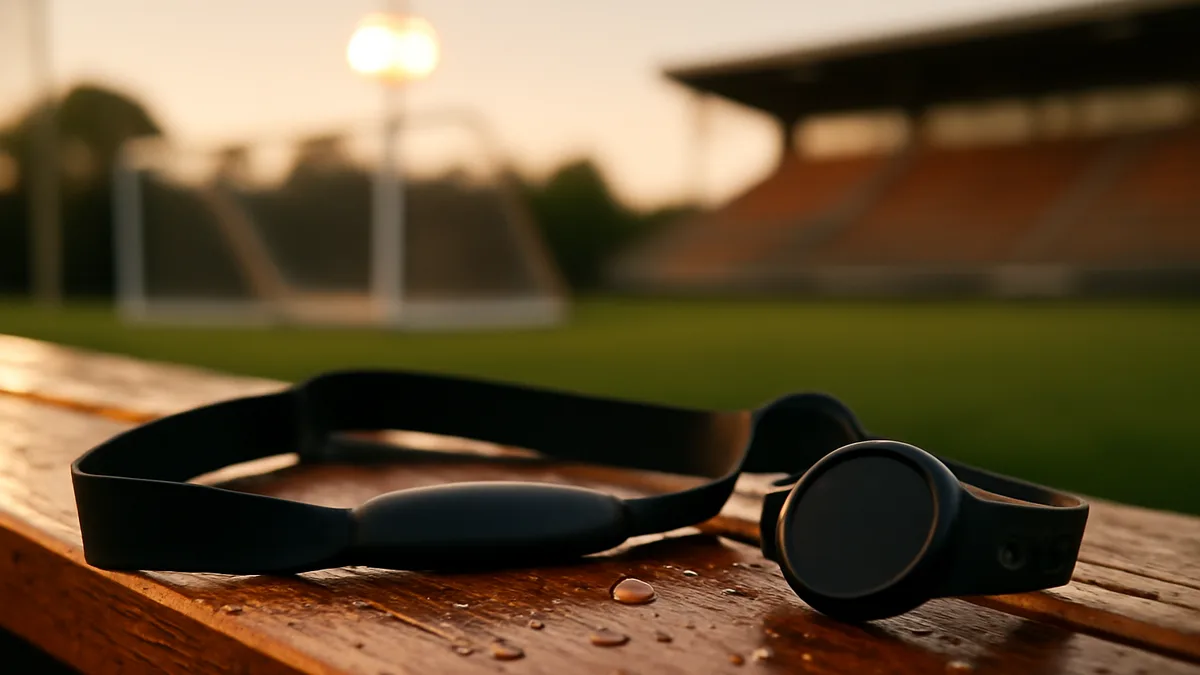
Choosing between a chest strap and a wrist heart rate monitor comes down to what matters most: accurate beats during high-intensity efforts, day-long convenience, or simple connectivity with apps and bikes. Both approaches measure the same signal classically attributed to the heart, but they do it in different ways and each has predictable trade-offs.
This guide lists the decision points in order of how often they affect buying choices. Each point gives a clear recommendation a buyer can act on. Sections after the list explain common mistakes, how to combine devices for interval work, and what differs for a beginner and for an experienced athlete.
Decision points in order of importance
Sensor principle and raw accuracy
Chest straps read the heart’s electrical activity and therefore provide the most direct and consistent measurement for beat-to-beat accuracy. Wrist units use photoplethysmography, which estimates pulse by sensing blood-volume changes under the skin and is reliable at rest and low intensity but prone to artifacts during rapid arm movement or muscle vibration.
Performance during intervals and sprints
Chest straps outperform wrist monitors for interval work because they show instantaneous changes in beat rate with minimal lag. If workouts include short, high-intensity repeats or sprint intervals, a chest strap gives clearer real-time data for switching effort zones and pacing rest intervals.
Fit, comfort and wearability
Wrist monitors win on comfort for everyday wear and sleep tracking because they are built as watches. Chest straps can be tight and irritate the skin for long wear; however, modern fabric straps and soft silicone modules reduce that problem. Comfort matters for compliance: a device that is worn consistently gives more useful longitudinal data.
Where each fails: motion and contact issues
Chest straps fail when contact to the skin is interrupted by loose straps, heavy sweating that dislodges the sensor, or when the strap shifts on very large chest girths; they also require correct positioning. Wrist monitors fail more often under wrist motion, when the optical sensor slips on sweaty skin, and when forearm muscle contraction or external impacts create noise that the sensor cannot distinguish from a true pulse.
Pairing and connectivity with bikes, multisport devices and apps
Chest straps generally use ANT+ or Bluetooth protocols designed for heart-rate transmission and pair easily to bike head units, gym equipment and most training apps. Wrist watches usually pair too, but some brands restrict broadcast modes or convert the internal sensor signal to a watch-specific data stream that is incompatible with certain third-party devices. Verify the required protocol (ANT+ or Bluetooth) before buying if external pairing is essential.
Battery life and maintenance
Chest straps typically run on replaceable coin cells or a small rechargeable module and can last many hours between charges; their simple electronics make them lightweight on battery drain. Wrist devices house bigger displays and more sensors, so they need larger batteries and more frequent charging when used for GPS, music or continuous recording.
Data fidelity for training zones and recovery metrics
For training guided by exact heart-rate zones, recovery scores and HRV-derived insights, chest straps deliver the most stable input. Wrist sensors are adequate for trend tracking and low-intensity endurance sessions, but expect more noise in the high-intensity zone and in variability metrics that rely on beat-to-beat precision.
Sports and use cases where each is preferable
Chest straps are preferable for cyclists using power and heart-rate together, rowers, cross-fit athletes, and anyone whose sport involves intense, jarring arm motion. Wrist monitors suit runners focused on pace, casual gym users, multi-day activity tracking, and people who want a single device for watches, notifications and sleep monitoring.
Durability and water resistance
Both types can be made waterproof, but a submerged chest strap must maintain skin contact to work reliably. For swimmers, look for devices explicitly rated for swim HR and check whether the manufacturer recommends chest or wrist placement for pool work. In general, straps tolerate sweat and repeated washing better than exposed optical modules on the wrist.
Comparing the two: a quick table
| Chest strap | Wrist monitor | |
|---|---|---|
| Accuracy | High for beat-to-beat and intervals | High at rest, lower under intense arm motion |
| Comfort | Can be less comfortable for all-day wear | Designed for daily wear and sleep tracking |
| Connectivity | Broad device compatibility (ANT+/Bluetooth) | Usually good, but some brands restrict broadcast modes |
| Battery/maintenance | Replaceable or small rechargeable cell, low drain | Higher drain if GPS or many sensors active |
How to decide: a short process
Start by listing the workouts that make or break a purchase: are they short, high-intensity intervals, long endurance sessions, or daily recovery checks? If intervals and ride/transient data matter most, prioritise an electrical sensor (chest strap). If a single everyday device and sleep tracking are top priorities, choose a wrist monitor. Next, check the connectivity you will need — confirm the device supports the bike head unit, trainer or app by name. Finally, consider comfort for the amount of time the device will be worn and the brand’s reputation for reliable strap materials or optical sensor design.
Where people go wrong
Buyers often assume the newest wrist watch will match a chest strap for every use. That expectation leads to disappointment when spikes or lag appear during hard intervals. Another common mistake is ignoring broadcast protocols — a watch that cannot transmit heart rate over ANT+ will not show HR on many cycle computers. Finally, many expect flawless swim readings from wrist optical sensors; swimming remains a challenging environment for photoplethysmography unless the device is explicitly designed for pool heart rate.
Beginner vs experienced athlete: what differs
Beginners benefit more from the convenience of a wrist monitor because adherence to a training habit is often the first priority; a single wearable that tracks steps, sleep and heart rate lowers the barrier to consistent data. Experienced athletes and coaches tend to favour chest straps for their superior temporal resolution and reliability during targeted sessions, and they often combine a strap with a bike head unit or lab testing for precise prescription.
What to do next
Decide the single non-negotiable use case (interval accuracy, continuous wear, swim compatibility or specific pairing). If interval accuracy is non-negotiable, choose a chest strap that supports both Bluetooth and ANT+. If daily wear and sleep tracking are non-negotiable, pick a wrist monitor and verify the brand’s optical sensor approach for activity types. Lastly, if uncertainty remains, buy a chest strap first — it is the lower-risk addition to most existing watch or bike ecosystems and can be used only when precision is needed.
Technical background
The two approaches rest on different sensing physics: chest straps detect electrical signals from cardiac depolarisation, while wrist devices use photoplethysmography to detect volumetric blood changes. That difference explains the distinct failure modes and why pairing a chest strap for sessions and a wrist watch for daily wear is a common, pragmatic setup for many athletes.
Frequently asked questions
Which monitor is best for interval training?
A chest strap is best for interval training because it records electrical signals directly and shows instantaneous changes with minimal lag. That makes it more reliable for short repeats, sprints and workouts where accurate on/off timing matters.
Can a wrist monitor be accurate enough for training?
Yes — wrist monitors are accurate at rest and during steady-state endurance efforts and are ideal for daily tracking and sleep. They are less reliable during high arm motion and for beat-to-beat variability metrics, so their suitability depends on workout type.
Should I use both a chest strap and a wrist watch?
Using both is a common solution: wear a wrist watch for daily tracking and add a chest strap for sessions that require precise heart-rate data. Confirm both devices can pair to the same apps or head units, or use the strap only when precision is required.


